
Trump Accounts: A New Way to Save for Your Children's Future

A new federal savings program is giving families another tool to build long-term wealth for their children. Created under the One Big Beautiful Bill Act (OBBBA) of 2025, “Trump Accounts” combine features of a retirement account with a head start from Washington, and in some cases, from the private sector too. Here's what you need to know, and how it fits alongside the college and gifting strategies we already use in your family's plan.

What Exactly Is a Trump Account?
A Trump Account is basically a modified traditional IRA opened on behalf of a child under age 18. A parent or guardian establishes and manages the account, but the child is the legal owner from day one. Once the child turns 18, the account converts into a standard IRA under their own control. The earlier the account is opened and funded, the longer the money has to potentially grow before retirement.
To be eligible, a child must be under 18 as of year-end and have a valid Social Security number. There are no income limits for the parent or guardian opening the account.
The Free Money: Seed Contributions
Children born between January 1, 2025 and December 31, 2028 who are U.S. citizens qualify for a one-time $1,000 federal contribution, deposited income tax-free. A separate philanthropic pledge, led by Michael and Susan Dell, may extend a $250 contribution to millions of additional children under 10 in households within certain income-based ZIP codes, though the operational details of that program are still being finalized.
For eligible families, electing into the program may provide an initial government-funded contribution, although eligibility requirements, investment restrictions, and withdrawal rules still apply.
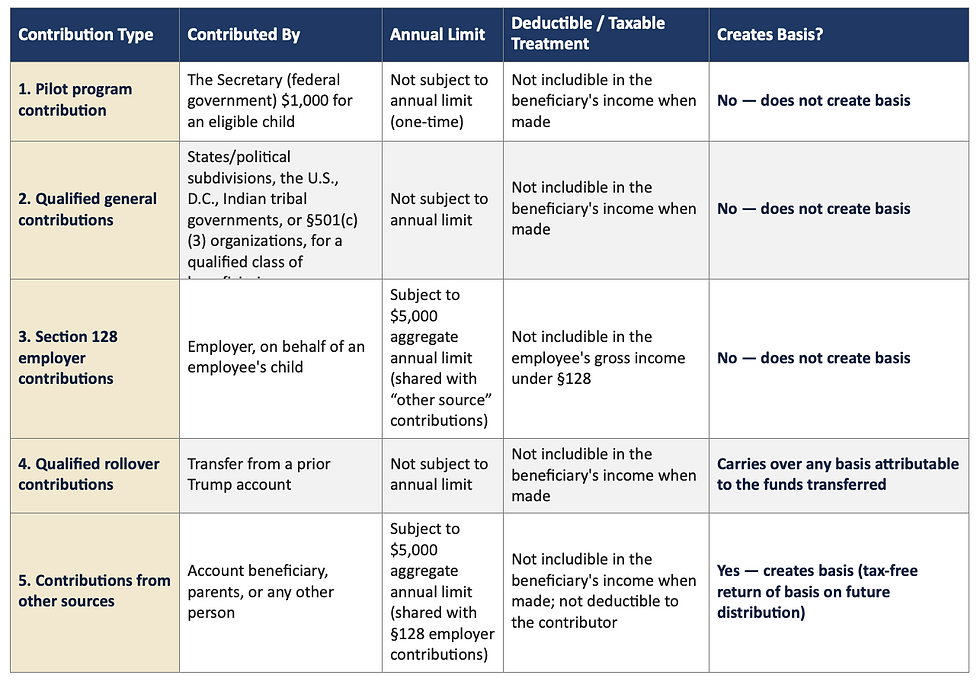
How Contributions and Withdrawals Are Taxed
Additional Notes
Trump Accounts largely follow traditional IRA tax rules, with a few unique details:
There is no compensation or earnings requirement associated with contributions, meaning that unlike IRAs, contributions can be made even if the account beneficiary has no includible compensation.
The $5,000 aggregate annual limit (indexed for cost-of-living adjustments after 2027) applies only to §128 employer contributions and contributions from other sources, combined. Pilot program, qualified general, and rollover contributions fall outside this cap.
Contributions from parents, family, or friends are made with after-tax dollars, meaning there's no tax deduction on the funds going in, but also no tax due when that portion (the basis) comes out.
Employers may contribute up to $2,500 per year on behalf of an employee's child. Those dollars aren't taxable when contributed, but they do count toward the $5,000 annual cap and are taxable to the child when withdrawn. These contributions do not create “basis” in the account.
Growth inside the account is tax-deferred, like a traditional IRA.
Withdrawals generally cannot begin until the year the child turns 18. From there, distributions before age 59½ are taxed as ordinary income and typically face a 10% early-withdrawal penalty, unless an exception applies (for example, qualified education expenses, a first-time home purchase, or disaster recovery, up to specified limits).
After age 59½, withdrawals are simply taxed as ordinary income, except for the tax free return of basis-no penalty, functioning just like a traditional IRA.
Trump Account vs. Other Child Savings Vehicles
If you're already saving for a child through a 529 plan, a UTMA/UGMA custodial account, or a custodial Roth IRA, here's how a Trump Account fits in:

Should Your Family Open One?
For most of our clients, a Trump Account is likely to play a supporting role rather than a primary savings strategy, particularly given the mandatory index-fund structure and IRA-style withdrawal restrictions. That said, it can be a meaningful addition to a family's overall plan:
Capturing the $1,000 (and potentially $250) in seed money for eligible children costs little and adds up over time with compounding.
Grandparents and other family members may find the $5,000 annual contribution cap a useful supplemental way to move assets out of a taxable estate while benefiting a grandchild.
Because the annual limit is shared across all contributors, and employer contributions carry different tax treatment, it's worth coordinating contributions across the family so nothing is inadvertently over the cap
How Do You Open a Trump Account?
Visit trumpaccounts.gov for full instructions on how to open a Trump Account. Download the app to do this right from your smartphone.
You can elect to open a Trump Account for your eligible children using IRS Form 4547. You can fill out and submit the form right in the Trump Accounts app, when you file your taxes, or through the secure IRS website called Individual Online Accounts, or IOLA.
If you have questions about Trump Accounts, call the Trump Account call center at 866-USA-4547.
Schedule an appointment with your advisor to discuss how a Trump Account may fit into your overall financial plan, taking into account its eligibility rules, investment limitations, tax treatment, and withdrawal risks.


Comments